
Tints: a Victorian colour game reimagined

Updated: Jul 14
This is our recreation and reimagining of the Victorian game of Tints by Jaques & Sons (188? ). We have recreated the colours based on modern colour theory, expanded the number of cards, and added index markers for ease of play.

The Original Jaques Tints game
Tints is a colour-based card pack, made for games where the colours enforce rules, but the games themselves readily belong in the standard game families. The original 28 cards were in 5 families, three of primary colours (red, blue, and yellow) and two of the mixtures (green and brown). Each family had a set of tints of the base colours, 7 each for red and blue, 5 for green and yellow, and 4 for brown.
These are the original games:
Game | Family | Core Skill |
Dit | Trick-Taking | Strategy, hand management, trump usage |
Traders | Set-Collection / Auction | Valuation, timing, risk-taking |
Waywee | Shedding / Race | Pattern recognition, forced-play optimisation |
Snappers | Reaction / Speed | Visual processing, reflexes, nerve |
Chromo Whist | Trick-Taking (Whist variant) | Partnership play (implied), trump strategy, colour tracking |
We give the full rules of the games below.
Our reimagined Tints pack
With the benefit of hindsight and a century of colour theory we can expand on the colour range, making an even spread of tints* from light to dark. By starting with the darkest colour sampled, and progressively lightening we made an expanded palette, and we gave new names to the tints**, to better reflect the range. Here are cards for the Blue suit

And similarly for the Red suit

For the Yellow suit, we expanded the gamut to 7 tints, and added black borders to the circles and letttering to enhance visibility:

For the Green suit we have:

And we increased the number of the Brown suit from 4 to 5.
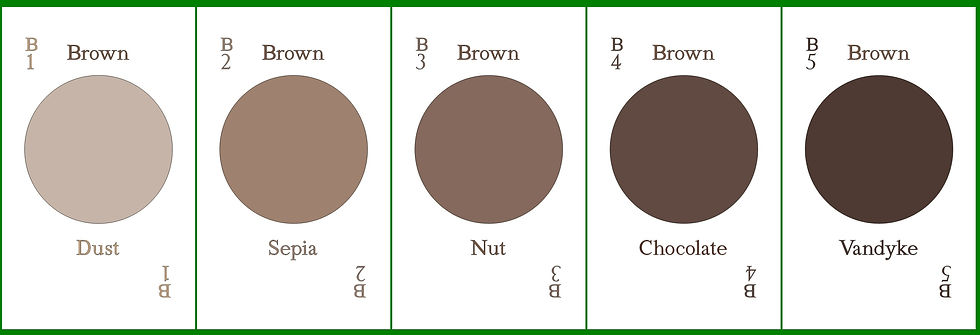
The Green suit has been matched blends of yellow and red (a new Orange suit) and of red and blue (a new Purple suit) each of 5 colours. Here is the Purple suit:

and here is the Orange suit:

You can set the additional cards aside if you want to stick to the original games exactly, or use the new cards to enable more players or more intricate strategies.
We also added a wild card to match the colour-play styling, featuring the 7 central hues. This was to enable grid-style games to be played, as well as the regular wild matching.

We'll discuss the games below: you can buy a set of our new Tints pack at Make Playing Cards here.
If you like games with colours as the focus, we have others to investigate, including, Rainbow, Ogdoad, Paintbox, Bauhaus Signals, etc. We'll be blogging these soon.
The rules of the Tints games
These are the games from the original booklet:
Rules & directions of various games that may be played with “Tints” Cards.
1.—DIT.
For two players.
The Red colour ranks highest, and the shades in each colour rank from the lightest (least) downwards.
Six cards are dealt to each player. The player who does not deal has to make four points in each turn; if he does not think he can do so he can change his hand for six fresh cards. The dealer must prevent his scoring, but if he has the colour that is led he must play it ; has the colour that is led he must play it ; bu if he has not that colour he may play Red. Each two cards form a trick, and each trick scores one point to the winner, but if the leader has not made four points he cannot score at all, the dealer scoring all he has made instead. If the leader makes four or more the dealer does not score anything. The deal changes after each hand. Game, 12 or 24.
2.—TRADERS.
For three or more players.
Each player has a supply of counters, and a pool of 20 is collected, each contributing equally.
The cards are dealt equally, face downward, the dealer keeping any odd ones until each player has examined his hand, and then turning them face upward one at a time. The player who has the next shade darker in that colour takes the card, but if the shade darker be not produced the player with the next shade lighter may claim it. Next,
The player on the dealer's left exhibits any card he choose from his hand, which is disposed of in the same manner. A player claiming a card with any shade but that next to it whether lighter or darker, is fined one point, which goes to the pool. Any unclaimed card must be left on the table till that player's turn comes again, when, if still unclaimed, anyone may buy it for one more counters (the highest bidder), the counters going to the pool.
The player getting the whole Green set exchanges it for six counter from the pool; Blue set for 5; Brown, 4; Yellow, 4 ; and the remainder for Red.
3.-WAYWEE.
For three or more players.
The cards are all dealt round face downwards, the winner of a game taking the deal in the next. A pool is formed by players putting in one or more counters each.
The player on the dealer's left begins, if he can, by playing any of the following “ Key ” cards :—Grass Green, Canary Yellow, Nut Brown, Poppy Red, or Lobelia Blue.
The card played is placed face upwards in the middle of the table, and the next player, if he holds same, can play either the next card lighter or darker of the same colour, and so on until the sets are completed. The lighter colours should be played to the right of the key cards, and the darker to the left, so that they may be seen.
Only one card is played by each player at a turn, but if a player cannot play any card at all he pays a counter to the pool, and the turn passes on. A player that has not either of the shades required in any colour, but has any one of the “key” cards, must always play same instead. The first player who plays out all his cards wins, and takes the pool.
4.—SNAPPERS.
For any number of players.
The cards are dealt round face downward, and each player collects them in a pack and places them, without looking at them, in front of him.
The player next to the dealer begins the game by playing his top card on to the table face up. The next player does the same, and so on round the table.
Whenever the next lighter or darker shade of a colour already exposed is turned up, the owner of either card who first cries "Tints” is entitled to claim as his own the other player's card, together with whatever cards may happen to be covered by it, and to add them to his own upturned pile.
If in doubt as to which was first, the disputed cards can be placed face upward in the middle of the table, and be won by any of the players who may happen to play the next shade of colour, either lighter or darker.
In the event of any player wrongly claiming a card, all the cards of his upturned pads must he forfeited and put in the middle of table as already stated
5.—CHROMO WHIST.
For three or four players.
Green colour ranks highest the shades of each colour rank from the lightest (least) downwards.
The cards are dealt equally, the odd card (if only three play) not being used. The player on the dealer’s left begins, and the others must follow the colour led if possible, The darkest shade of the colour led takes the round, unless Green be played, when the Green colour wins. The winner in each round scores one point If Green be played immediately after Blue, or Blue after Green, the player loses one point. Game 15.
The following is the list of colours contained in the pack, numbered in correct gradation from No. 1 (lightest) downward :—
Some suggestions for new games
We have created some new games to play with the new explanded pack. If you think of some others, please let us know
Game | Family | Players | Core Mechanic | Approx. Play Time |
Spectrum | Set-Collection | 2–4 | Rummy-style ladder-building | 20–40 min |
Shade Thief | Memory/Matching | 2–6 | Memory + strategic stealing | 15–30 min |
Gradient | Solitaire/Puzzle | 1 | Grid-swapping optimisation | 10–30 min |
Chromo Bridge | Trick-Taking (Whist) | 4 | Bidding + trump strategy | 30–60 min |
6. — SPECTRUM
A rummy-style set-collection game for 2–4 players.
Object: Be the first player to complete and lay down all five colour ladders (or reach a target score over multiple rounds).
Setup:- Set aside the Wildcard. Shuffle the deck. Deal 7 cards to each player (6 cards for 4 players).- Place the remaining deck face-down as the draw pile.- Turn the top card face-up to start the discard pile.
Colour Ladders: A ladder is a complete set of all shades in one colour family, arranged from lightest to darkest. Each family has a different length:
Colour | Number of Shades |
Green | 5 |
Brown | 4 |
Yellow | 5 |
Red | 8 |
Blue | 8 |
(Total: 42 cards)
Play:- On your turn, draw one card from either the draw pile or the top of the discard pile.- Then discard one card from your hand face-up.
Laying Down:- Once you have a complete colour ladder (all shades of one colour), you may lay it down in front of you. Laid-down ladders are safe and cannot be stolen. You may also add cards to incomplete ladders already in front of you (including your own), but you cannot rearrange them once laid.
Stealing (optional advanced rule):- If you hold the exact next lighter or darker tint to a card in an opponent’s incomplete ladder (one they haven’t laid down yet), you may on your turn steal that card by playing your matching adjacent shade and taking theirs. This adds a “Tints” flavour to the rummy mechanic.
Winning:- The first player to lay down all five complete ladders wins the round.- For a longer game, play multiple rounds and score:- Green ladder: 5 points- Brown ladder: 4 points- Yellow ladder: 5 points- Red ladder: 8 points- Blue ladder: 8 points- First to 30 points wins the game.
Strategy Note: Red and Blue are worth more points but are harder to complete (8 cards each). Green and Yellow are shorter and faster to finish. Brown is the quickest—but worth the least.
7. — TINT THIEF
A memory and matching game for 2–6 players.
Object: Collect the most pairs of adjacent tints by remembering where they are hidden.
Setup:- Shuffle the deck and lay all cards, including the wildcard, face-down in a grid (e.g., 6×7 for 30 cards, or adjust for fewer players).- Players take turns.
Play:- On your turn, flip two cards face-up.- If they are adjacent shades in the same colour family (e.g., Apple + Grass, or Lemon + Canary), you claim the pair and keep them (this is indicated by the tint numbers). If they are not adjacent, flip them back face-down in their original positions. Wildcard counts as adjacent for any card.
The Thief play:- If you flip a card that is exactly one step lighter or darker than a card already claimed by another player, you may steal that player’s card and add it to your collection—provided you can show the matching adjacent card from the table.
Winning:- The game ends when all cards have been claimed.- The player with the most pairs wins.- For a longer game, play multiple rounds; each pair scores 1 point, and bonus points are awarded for completing a full colour ladder (all shades of one colour): 5 bonus points.
Age Variant (for younger players):- Remove the Thief rule.- Simply match any two cards of the same colour (not necessarily adjacent). This becomes a standard Memory game of colour recognition.
8. — GRADIENT
A solitaire puzzle for 1 player.
Object: Build all five colour ladders from lightest to darkest in the fewest moves possible.
Setup:- Shuffle the deck and lay all 42 cards face-up in a 6× grid (or 7×6).- Take a moment to study the layout.
Play:- You may swap any two adjacent cards (horizontally or vertically) on the grid.- Your goal is to rearrange the grid so that each row (or each column—choose before starting) contains a complete colour ladder in correct light-to-dark order.- For a harder variant, arrange the grid so that both rows and columns form complete ladders (a Latin-square style puzzle).
Scoring:- Count the number of swaps you make.- Beginner: Complete the puzzle in under 50 swaps.- Intermediate: Under 30 swaps.
Expert: Under 15 swaps.
The Tints Connection:- This solitaire variant directly teaches the gradation logic of the deck. After playing it a few times, players will instinctively know which shade comes next in every colour family—making the multiplayer games much more competitive.
Variant: Patience Gradient- Instead of swapping, deal the cards into five face-down piles. Flip one card at a time and try to build ladders in a tableau (like Klondike Solitaire), moving cards between columns only if they are adjacent shades in the same colour.
9. — CHROMO BRIDGE
A partnership trick-taking game for exactly 4 players (2 vs. 2).
Object: Score the most points over a series of hands by winning tricks and correctly bidding the number of tricks your partnership will take.
Setup:- Set aside the Wildcard. Partners sit opposite each other.- Shuffle and deal all 41 cards (10 cards each, with 1 card left over—this is placed face-down as the Widow cardand not used in that hand).- The dealer shuffles and deals; deal passes clockwise each hand.
Bidding:- Starting with the player to the dealer’s left, each player bids a number of tricks they believe their partnership will win (minimum 1, maximum 7).- Bidding goes around once. The highest bidder names the trump colour for that hand (Green, Brown, Yellow, Red, or Blue).- The bidding partnership must now win at least the number of tricks they bid. The opposing partnership tries to prevent them.
The winner has the option of swapping a card for the Widow card if they want.
Play:- The elder player leads the first trick by playing any card from their hand.- Players must follow the led colour if they can.- If they cannot follow the led colour, they may play any card, including a trump.- The darkest shade of the led colour wins the trick—unless a trump is played, in which case the darkest trump wins.- If Green is trump, it beats all other colours. If Blue is trump, it beats all except Green (as in the original Chromo Whist rule).
Scoring:- If the bidding partnership wins at least their bid, they score 1 point per trick won.- If they fail to make their bid, they lose their bid amount (negative points).-The opposing partnership scores 1 point per trick they win, regardless.
Bonus (from original Chromo Whist):- If a player plays Green immediately after Blue (or Blue after Green), their partnership loses 1 point (this discourages “colour-chasing” and adds a tactical layer).
Game:- Play until one partnership reaches 21 points.
Strategy:
- Green is the strongest trump (beats all), but Brown, Purple and Orange are weak (only 5 tints). Bidding high on a weak trump colour is risky.
- Red and Blue have 7 tints each, giving you more options—but also more cards for opponents to use against you.
Remaking Jaques games
The nineteenth century saw an explosion in game design, in part because of the new manufacturing processes, and in part because of the increased sophistication in thinking about the nature of games. In particular, the designers at Jaques and Sons invented a slew of novel games that were free of any associations with traditional gambling games, perhaps to appeal to the sensibilities of the new middle classes. Most of the games came and went quickly, others such as Snap and Happy Families are still with us.
New Tradition Games is drawing on its private stock of the original games to make new versions as we believe that the games still have a lot to offer the card-playing community.
Tints is the first of a dozen Jaques games we are recreating and reinventing from the time.
Notes
* The tints of a colour are a progressive lightening by adding a component of white. A shade is a progressive darkening by adding increasing amounts of black. Adding both at the same (ie grey) results in a series of tones. You can learn more about this at Wikipedia here. In our Rainbow reimagined game, for instance, there are tints and shades of the primaries as part of the playing. In our recreation of the game, we added the missing tint of yellow, Primrose. We have used common names and colours where possible.
** See end of previous note.


Comments