
Dana: On Court Cards

We have posted elsewhere about a quite remarkable Americana game, Bishops Whist, invented by Alphaeus T Dana in the 1890s. His book on the game began with an essay that filled half the pages, so we have decided to include it in its entirety hereunder:
Dana's Essay (Mostly Historical)
Wherein We Discern an Historical Apology for the Rankings in Bishops Whist
In Charlemagnes day, a period in history wherein we behold the feudal system in the zenith of its strength, the gulf which lay between the nobility and the common people, was as wide as that which yawns between the lowest level of the earth, and the crest of the loftiest cloud. The kingdom of France was then divided up into great fiefs, ruled by peers, or barons, who held absolute sway over everything within their domains, even the lives of their tenants, serfs, as they were called. Deeds executed in those times conveyed to the purchaser, not only the land and houses, but also the people, or tenants, dwelling thereon. The dark ages we of today term that period during which the feudel system existed, an epoch of time which laps over a thousand turbid years of desolated human history extending from 400 to 1400 A. D., or thereabouts. Centuries of human existence wherein the strong plundered the weak at will, and no strong arm to interpose. A time fruitful in ruthless, barbaric wars, in tilts and tournaments between men cased in steel armor, and in fanatical crusades, in the tumultuous folly of which uncounted millions of the human race miserably perished, the very chronicles of which seem only like inscriptions to human folly and superstition. In whatever light we of today may regard the dense ignorance, the superstition, the ruthless barbarity characterizing that age, who of us can be wholly insensible to the gorgeous dignity of that thousand years of feudal history. Could we with a wave of the hand conjure before us a long possession of feudal life what an array of half barbaric glory would greet us. Walled cities and castles without number, gloomy monasteries, magnificent cathedrals overtopped by glittering spires, kings and queens clothed in purple and gold and wearing jewelled crowns, bishops and cardinals habited in cassock and mitre, and none the less interesting than any, a multitude of knights clad in mail and armed with sword, shield, and battle-ax. History affords no character around which so strongly clusters the one idea of the heroic as the knight. Valient by reputation at least was the knight, and we of today, in fancy, picture him stern and dauntless in his armor coat, and withal as grim as the very shadows of the castle archways in the shades of which he so often loitered.
Over in France in those days, about 1396, a melancholy king sat on the throne, and to ease his despondency, his courtiers invented playing cards. These devices containing as they did four suits, or classes, they endeavored to make represent the four classes of society in the French kingdom, each class having its own kings, queens, etc. For instance, they designated one of these card suits the military class and distinguished it by putting on the representation of a pike, or spearhead, because the military were armed in those days with spears, hence the spearhead most fittingly typified the military class. We of today term this spearhead a spade.
How the inventors of cards in their efforts to render their cards a miniature, or representation, of the different classes of people in the French kingdom, faint as those endeavors may appear, should neglect to put in the bishop and castle with their kings, queens, etc., may well surprise us. What attempt to copy feudal society by card cuts should we say half succeeded, lacking the bishop and castle, objects, or dignitaries if you so please to term them, quite as conspicuous in that age as kings or queens. Let us admit how much better the chess-board with king, queen, castle, bishop, knight, has succeeded in reproducing the feudal rankings than the old time card packs.
Oddly enough it must appear that in the five hundred years which have lapsed since 1396, the date when playing cards were first produced, it appears that no attempt has been made to re-arrange these old time cards in any order of ranking consistent with historical accuracy. The reason becomes obvious when we consider that the bishop and castle had never made their appearance in the packs, hence of very necessity with ace, king, queen, and jack or knight as the fourth rank card, nothing like historical accuracy could possibly be obtained, but in lieu thereof, a mere half correct mathematical grading of kings, jacks, etc.
A review of the history of the five centuries which have elapsed since cards were first invented reveals the somewhat piquant fact that while in that period of time all the great branches of the world’s literature, poetry, the drama and romance alike, have developed to perhaps extreme perfection, card literature, or to speak precisely, card packs, have remained like the stone statues of Pharaoh’s day, at a standstill. This statement must not be misconstrued to mean that great progress, and even perfection, has not been attained in the finishing up of the literature and structure of particular games, more notably whist, but that our card packs had never expanded into the full stature of their original possibility and significance. That is to say in plainest parlance: card packs, lacking the bishop and castle, come far short of miniaturing feudal society, even in a mathematical sense, for you might as well strive to count ten without repeating the numeral eight, or nine, as to undertake to make pictographs of feudal dignitaries correctly ranked, lacking the castle and bishop. Of card games we are blessed with a most bountiful harvest. In some of them the ace ranks as the highest card, in yet others it is the lowest card, while in still other games, the king, or jack, stands as highest card. Invention may be said to have outdone itself in the way of constructing new games played with the old time cards having ace, king, queen, jack, as dignitaries. Provided we search throughout the maze of incongruity and oddity which makes up the mass of literature devoted to old-time card games we fail to discover any new card character pretending to any historical significance. We meet only the same court cards, ace, king, queen, jack, merely set in a new relationship to each other, according to the game played.
Who of us so bold as to deny that the chess-board affords the best miniature of feudal society or ranking yet devised, with king, queen, castle, bishop, knight, all the prominent characters represented. Establishing this undeniable fact in mind let us admit that with the bishop and castle added to our card packs we preforce group together the most complete pictographic complement of feudal society practically possible in card pictographs. More complete perhaps from an all around glance than the chess-board affords for the cards may give us kings, queens, knights, etc., more life-like Yet again should we draw the line of comparison closer the smaller cards, counting from the nine spot down, make up a better mathematical grading of the underlings which thronged the feudal lord’s domain such as forester, smith, page, etc. History affirms that the forester occupied an important office for he stood responsible for all the game on his lord’s domain. Let the nine in our card pack represent the forester, the eight the smith, the seven the butler, and so on down with the two spot as page, and we develop a very pretty mathematical grading of the feudal underlings dwelling about old-time castles. On the chess- board, however, while the principal pieces are correctly graded, the inferior pieces, the pawns, stand equal in rank. Of course for practical uses such ranking of the pawns is the only feasible one, but the fact shows plain when we tighten the lines of comparison between the cards, and the chess-board, that the balance of capacity to reproduce feudal society, or dignitaries, lays with the cards.
To those accustomed to the rigid exacitude of modern whist the new game will doubtless, at first sight, present such structural irregularities in the peculiar rank and action of the knight, as to excite comment. The fact must be kept in mind however, that we have not taken old time whist as our guide or standard in devising the new game, not that we have regarded old whist as insufficient as a standard of proprieties, but because we have gone back to feudal society itself as a standard of ranking. Who so bold as to proclaim that the knight properly ranks as fourth best character in middle age history, surely no one, and yet he stands as fourth best character in all the whist the world has yet known. Provided we group together historical characters and stand them each in the proper place in the class, how can we do less than go further, bestowing upon each the correct historical action in the game. Illy would it suffice that we present the accurate cut of a knight in the pack, and fail to give him the right historical movement in the play of the cards. Since any one, or even all, of the four knights in Bishop Whist, rank as a ten spot in any one, or all, of the non-trump suits which lead, arguing from the structure of the game it must appear theoretically that, one, or four knights, might chance in the course of play to be dropped in on any of the non-trump suits, and in consequence render that particular suit thirteen, fourteen, fifteen, or even sixteen cards long. Admitting such an event to occur in play, no harm might undubitably ensue. Theoretically such possible happenings cannot be denied, but when we settle down to the basis of actual play these startling theoretical crudities fade out of sight like morning mist from the very fact that the knight is mostly held back to capture last trick, being seldom parted with except in the case of the knight’s revoke. In consequence the business governing of the game may be said to completely nullify the theoretical irregularties.
Irregularity is, however, one of the marked essentials in dramatic construction, but its limit must be proper and circumscribed of course. To show the strong relationship existing between the drama, and a card game, would prove no very laborious task. We have the characters for our card play in the kings, queens, etc., as truly as in the stage play. The table forms the stage, and each card as it falls in play is but a mute actor coming forward to enact his part. Thus we see how closely allied in structure should be the game of card to the drama. Broadly speaking, the drama does not appeal strictly to the intellect alone, that is to say, when we behold a drama we are not put to a great mental task to enjoy it. It sweeps into our whole comprehension, just as does the beauty of the landscape, without tiresome mental effort. Suppose now we take a play before the actors come on the stage and tear out all of those parts wherein anything odd, or irregular, can possibly happen. Let us plan and precalculate every act so that none of these haphazard events, such as surprise and delight the mind can take place, in short, to eliminate all the elements of luck, such happenings as quicken the mind to a sudden conception that dame fortune wrests the helm from our grasp and ordains things as she will, for the moment at least, and what have we done with our drama? Nothing more than transmuted it into a veritable multiplication table, exact, it is true, but at the same time, barren of the quality of the irregular, and consequently less dramatic, while possessing less significance as pastime.
The new game is not gotten out to modify or improve old whist, but as an original, pastime game. The introduction of the bishop and knight, the latter, minus a pip, and characterized by a peculiar rank and action, precludes anything but a distant resemblence between the two games. Many things in the new game will appear loose-jointed to the deciples of old whist, acclimated as they are to the mathematical precision of modern scientific whist. The irregular rank and action of the knight without pip, being at once essentially new, and so totally at varience with the precise exactitude of old whist as new formulated, and again, the fact of one point being allowed for bishop cut the dealer, may appear antagonistic to the end of casting out all elements of luck in the game, for the stroke of cutting a bishop depends wholly upon chance, and nothing whatever upon skill. In fact the one point so allowed for bishop cut the dealer, looks more like eliminating the idea of skill in a game, a tendency diametrically opposed the pronounced code of modern whist authors, who announce that they have striven to eliminate all elements of luck in the game. Nevertheless this allowing of one point for bishop cut as a trump card is quite in harmony with the idea of pastime in a game, for the act lends added dignity, mirth and zest to the deal, and whatever in a game quickens the mind to pleasureable anticipation becomes a part of pastime.
Five hundred years is a long space for any devises to hold their place in public esteem, yet cards have done so. One might fancy that they had grown gray in the public service, and that consequently if no vistige of Elijah’s mantle remained with which to cover them, the mantle of public esteem at least might well rest upon them.
That such pictographs containing kings, castles, bishops, etc., placed in such corelation to each other as to miniature to some extent, feudal society, should be intrinsically bad of themselves, any more than the drama, or history itself, from which the suggestion of cards was first derived, or that they could be anything which might not grace a pulpit, or parlor table, would also be a surprise to sober minds. Cards can be said to be educational factors to some limited extent, and like all else in the world, moral enough, if but put to moral uses.
Nevertheless much odium has been heaped upon cards, wrongfully poisoning the public mind against them, with little show of reason it appears. None can deny that cards have been put to the worst uses by gambling with them, but the lessons of history declare that mankind can convert any good thing into evil uses, not excepting the Bible itself. Are we blind to the frigid fact, that our forefathers were greivously persecuted and at last driven from their homes in England, to seek a shelter in the wilds of America, not because they played cards in England, but because they had Bibles there. This stern fact, however, in no wise proves the Bible a bad book, on the contrary, it only shows how Holy Writ had fallen into bad company. The same rational argument may be applied to cards. Because some degrade them by gambling with them in no sense evinces that cards are intrinsically bad of themselves, but prompts the suggestion that the cards have fallen into evil associations.
The Bishop
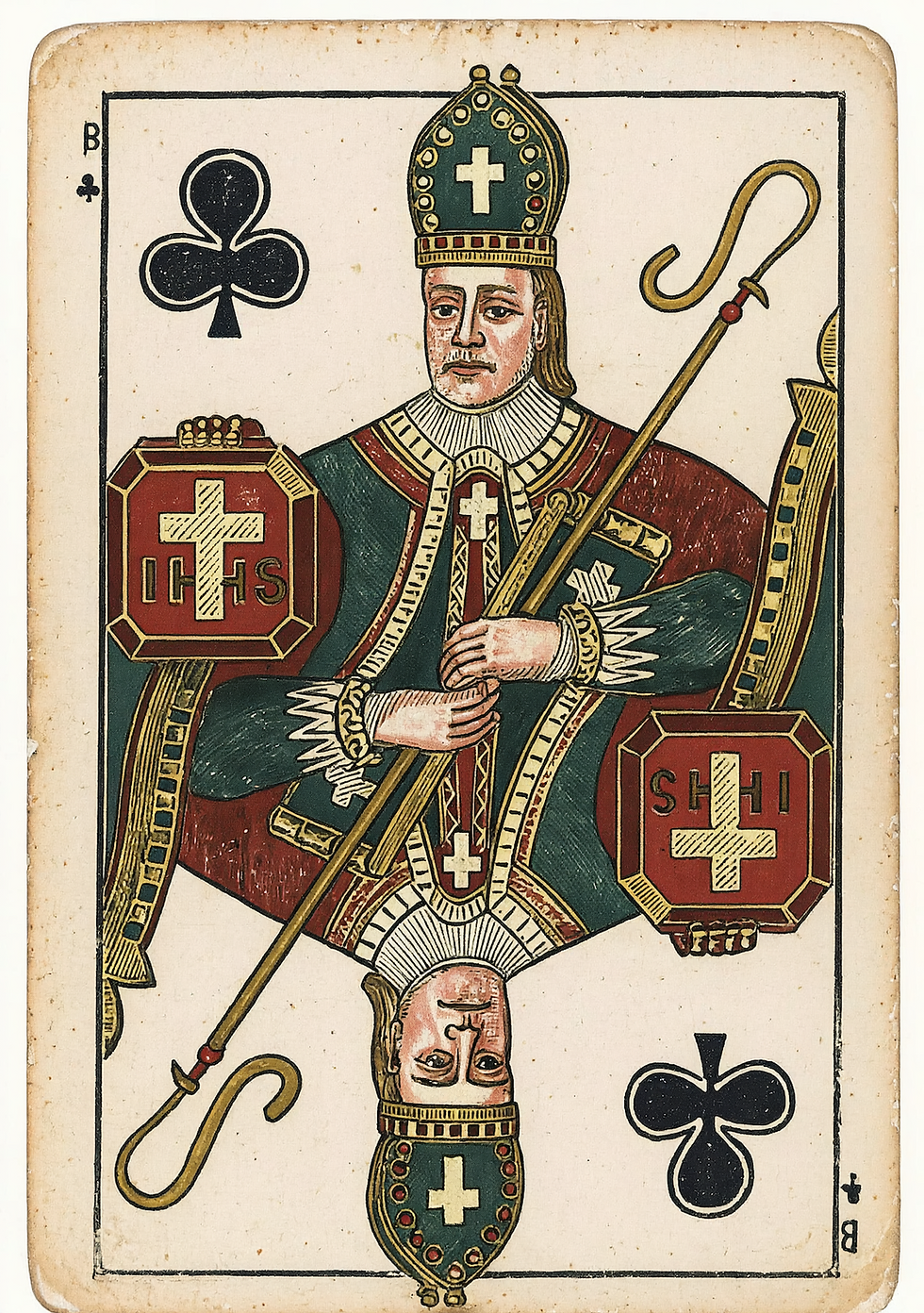
The bishop stands out as one of the most conspicuous and important functionaries which gave added worth and lustre to society in mediaval days. Some idea of the pomp and consequentiality with which this swell fellow of the middle ages bolstered himself up before the eyes of the world may be gathered from a brief description of Wolsey, Englands great cardinal who figures so loudly in the history of Henry the VIII of whom the chronicler says : He was made chancellor and had a train of eight hundred servants some of whom were noblemen’s sons ; his cardinal’s hat was borne aloft by a person of rank ; a priest walked before him carrying a pillar of silver surmounted by a crucifix; the walls of his palace were covered with cloth of gold ; the rest of his furniture was splendid in proportion. What a picture of earthly pomp and consequence is not here shown up. Turn we where we will during the middle ages, in England, France, or elsewhere in the Christian world, our ears are greeted with the same loud story of the bishop and we behold the same garish figure of this church functionary, who next to the King, personates the very haughty and pompous magnate of the middle ages. Inasmuch as wealth, pomp and pride, raise men to prouder heights in the world’s esteem the bishops record in the past history of our race shows as gaudy as a golden thread woven in garlands of purple, and festooning the altars and sanctuaries of our race. Yes, the great shadow of the past which seems to flit athwart the sombre history of the byegone like a stately and dignified phantom, hovering about the arches of magnificent cathedrals and kingly palaces, is the bishop. Of Thomas a Becket, a cardinal who thrived two hundred years or so before Wolsey’s time, history declares: No subject before his time had displayed so much pomp in his retinue, or splendor in his furniture, the king was his frequent guest. History affords us no happening which sheds so much light upon the conseqentiality of the clergy during the middle ages as that of Henry II, kneeling before Becket’s tomb while a trio of priests scourged his naked back. The king in a fit of spleen had incited some of his courtiers to stab Becket to death, and so in penance the king knelt before Becket’s tomb while priest scourged his naked back, thus to expiate his crime. That event took place about 1150 A. D.
When we look back over the history of Christian races how easy for us to discover how much added worth and dignity the bishop has bestowed upon society. With what blank dismay should we not stare into the great chasm in the chronicles of our race were all the memories associated with the bishop totally obliterated. Place a rudely sketched landscape drawing before you ; now take your pencil and connect the shapeless outlines of rock, and tree, and meadow; brighten and burnish every cloud streamlet, and woodland shape, in the wondrous beauty of autumn purple crimson and gold ; make this painting now more lovely yet with the rosy hue of an autumn sunset; silver the placid water with the sheen of a full orbed harvest moon and cast its mellow gloaming over meadow, forest, and hilltop, until you have breathed upon your picture the mystic witchery of enchanted land where fairies might romp and revel. Thus, in beautifying your canvass you have done to it only what the bishop has done to our Christian history, for he has enriched it with a record of glittering spires, golden crosses and sanctified altars. Yet, for all his saintly magnificence the impress of history betrays the bishop with a dark side, and very dark that side is. Over in merry England long, long ago, the bishops fell to disputing about such quibbles as this: does bread kneaded in flour, yeast and water, and baked in a bakers’ oven, perchance by a freckled-faced maid, whether such bread we say. when blessed by a bishop, become thereby actually transmuted into the body of Jesus. Christ. Some bishops proclaimed yes, and others stoutly maintained no, and in the heated dispute the bishops speedily got by the ears, and one set of bishops gaining advantage over the others, laid violent hands on them, chained them to stakes driven into the ground, and piling combustibles about them cheerily set fire thereto, speedily burning the bishops to death. Whether the phrase “Merry England” arises from the fact that the bishops made so merry burning each other to death may perhaps never be surely known. Alas! to often the savagries of this haughty and sumptuous fellow would have brought a blush of shame to the savages of Patagonia. Yet our existence on the whole has been brightened by the bishop; take away his altars, his bibles, his crosses, his golden promises, and it is as though the firelight at our hearthstones smoulders away into sombre darkness until out of the gloom of dying embers, mocking shadows arise, glowering darkly on every bright hued hope that quickens the heart into gladness over immortal life. Truly, in the bishop we behold the great garish puppet of Christian history. More valuable to society than kings or princes, because more stable and hope inspiring, the very good, the very naughty, the very imperishable bishop. Kingdoms may be overthrown in the mad war of human strife, but the bishop keeps his peace with us today, the one really imperishable dignitary of the darksome past. A most gaudy phantom is he, who glides forth out of the wreckage of an old and decaying civilization, to erect anew today his gilded spires and consecrated altars. The bishop never dies. When at midnight in 410 A. D., the savage host of Huns burst through the gates of imperial Rome, butchering her citizens and laying the ancient city, its temples, its princely mansions in ruins, the bishop survived the shock. It was as though amid the ashes of blood-drenched streets, ruined temples, and desecrated altars, that the great wizard of the spaceless skies had shaken his magic wand, conjuring forth from that pall of smouldering fire, blood and ruin, a phantom figure, clad in cassock and mitre, commanding it to arise and stand forth forever, to erect anew its consecrated altars. What wonder indeed that this gorgeous poppet of byegone centuries, a personage so valuable and conspicuous in feudal history, one who has done so much to dignify and make stable society, both past and present should not have been accorded a place in old-time playing cards, devised as they were in the very meridian period of the bishops consequence.
Let us trust however that the public may welcome the debut of his reverence in playing cards with as much complaisance as becomes his sanctity, thus compensating this arm-in-arm fellow with kings, for centuries of slight. Since then a cursory glance backward in history reveals how deeply society is indebted to the bishop, adding to it as he has so much worth, stability and dignity, not only in the past, but also the present, we bestow on him the same value and consequence in our new card kingdom, (of itself a sufficient miniature of feudal society,) that he occupied in mediaeval days, establishing him as fourth rank card, and making each bishop worth two points in the game.
Let no one fancy that the bishop has fallen into evil company in our card packs. He is no whit more out of place there, than on the Chess board, in history, or in the drama of which the card game should, in some measure, be but a reproduction. If the bishop then adds lustre to the drama and to society, let us enjoin him to shed some little ray of his uplifting influence athwart our card tables.
The Knight
Beginning at the king and descending in the scale of feudal society, passing the bishop in our downward course, we come to the knight, by all means the most interesting and romantic character which the shadowy past has bequeathed to us. As a distinctive character in history the knight sprung into existence about the 10th century, an age in feudal history which shows up in the strongest light the injustice and tyranny of the lords and barons. At that time the entire realm may be said to have been in absolute possession of the nobles who fortifying themselves in strong castles plundered each other as well as the common people with rapacious lawlessness, bidding defiance even to the king. An age characterized by oppression, superstition, and wrong, when the strong felt themselves entitled to hold as much as they could wrest from the weak, and needless to say in such a state of affairs the defenceless were exposed to great and continual danger.
Amid the turbulence and disorder of such a state of society came forward certain brave knights vowing themselves to defend the helpless. Their example being contagious a great body of knights soon sprung into existence to side with the oppressed. At first, each knight served a long apprenticeship at the castles, taking charge of the horses, as well as their lords armor, besides various other offices, such as carving at the table, and were at length confirmed as knights, a ceremony requiring many religious ceremonies which ended by striking the knight with the flat of the sword. From that hour he was a free man, at liberty to roam the wide world over whithersoever he would, always bound by a vow to defend his country and religion, and to succor the helpless. Halting wherever night overtook him, paying no toll, vassal or slave to no lord or baron, belonging to no one class in society, and needless to say, always welcome at every castle gate and freely entertained so long as he chose to stay. However laughable the author Don of Quixote may have afterwards rendered the character of the knight, this same grim fellow sprang into existence as the very child of the most chivalric emotions which animate the human heart. Today, not a cut of ancient castles but that stands out in bolder relief and is rendered more impressive to us by the figure of a knight in mail loitering in the shadow of its oldtime gateway. Ordinarily the knight did not rank very high in the scale of feudal society, but he always bore about him in his wanderings as much fear and respect as his renown and prowess might inspire. Queerly enough, however, it sometimes came about through the shifts of fortune or circumstance that the knight outranked even kings and princes, in a way very peculiarly his own, for what is it to slay a king, but to outrank him, or to defend and deliver a castle, but to outrank that also. History affirms that the valor knights has often preserved to kings their sceptres and to barons their castles. At the battle of Poictiers the French king threw down his gauntlet before a knight of Arras. Rufus, king of England, once riding in the forest was attacked and unhorsed by a knight who drawing his sword was about to despatch him when the king cried out hold! knave, I am the king of England. This one little incident affords us a very good example of the sometime occasions when the knight outranked the higher feudal dignitaries, simply by virtue of his immediate prowess. Nor are such incidents scarce in feudal history. Now the groundwork of feudal rank springs from different sources. The king ruled by virtue of his hereditary right descending from father to son, generation after generation. The bishops station rested solely upon the supposed scanctity of his office, but the idea associated with the rank of the knight is that of valor. Nothing stands out plainer in history than the fact that the knight belonged to no one class in society and as the pack with knight, bishop, castle, is considered in the light of a miniature of feudal society the same idea is carried out therein, for which reason the cut of the knight has no pip or spot, demonstrating that he belongs to no particular class in card society, but simply to the pack or card kingdom at large. Again, since in ancient days the knight occasionally outranked kings and queens, as we have already shown, simply by virtue of instant prowess on some fortuitous occasion, we incorporate the same idea associated with the knight in Bishop’s Whist and in one trick out of the thirteen make the knight outrank all other cards, high or low, of whatever suit, not excepting trumps. This one trick is styled the “Knights trick,” the same being the last, or thirteenth trick, of every hand played, when the knight absolutely outranks all other cards.
The Ace
Abstractly speaking, the community at large may be said to be little else than a row of human figures mostly on dress parade, where every person’s rank and social standing becomes as fixed and certain as the figures on the multiplication table. Equally certain it is that there exists, mathematically speaking, a strong resemblance between the various individuals of society, insofar as their rank and influence upon each other is concerned, and the thirteen cards which go to make each suit of our old-time playing cards. The ace, or onespot, to speak with greater propriety, should after this mode of reasoning stand at the very foot of the class of thirteen cards, being primarily, nothing else than the onespot, the very lowest and humblest individual in card society. The twospot stands for a person of yet little more influence, the threespot, one of yet higher rank and consequence, and so on up to the King who in regal robes we should all say occupies the highest place in card realms. How comes it about then that this little inferior onespot, designated the ace, should be placed in card games above the king and outrank him. Surely at first sight, this oddity or extravagance, seems to do violence to the natural order of things seen about us in the world, quite as though we should render the figure one of greater value than the figure ten. What confounding of our senses is this when a onespot outranks the mighty King, robed in the majesty of regal garments. Let us go into the country, take a cock from the roost, bear him to the great balustrade of the king’s palace and loudly proclaim, “the cock outranks the King.” Such extravagance would seem scarcely one whit less bizarre than that which places the ace, the very humble, insignificant, almost worthless little onespot, above the king in card games. Card packs let us bear in mind are, mathematically at least, little card kingdoms, no more or less. When however we take pains to analyze the varied qualities which make up the budget of human character the mystery or oddity of putting the onespot above the king clears up somewhat for we find queerly enough that there lurks in the human mind a tendency to bestow great worth, power, or consequence upon odd, extravagant, or mysterious objects, diminutive though they may be.
This queer disposition of the human mind becomes markedly noticeable in Oriental literature wherein we so often see diminutive dwarfs, tiny fairies, or perchance decrepted old witches, insignificant enough in themselves as compared to the majesty and power of caliphs and princes, but who by their mysterious art and incantations so often bring to naught the plans of mighty rulers. Many a delightsome fable or fairy story, in the world’s literature has found its birth place in this same tendency of the human mind, to invest diminutive objects with startling powers. To bring out a clearer illustration of this same idea. How many of us in youthtime have not been so carried away with the extravagant antics of some circus clown as to glorify him for the time being, his ludicrous antics raising him in our approbation far above every sober and dignified object that we saw in the world. History presents one very notable instance of the exhalation of the odd and ridiculous, above the dignified, in Cromwell’s day when they got together a parliment composed of the very dregs of the people. We all know how this stupid assembly sat in parliment hall promulgating for a brief season, law to the great English realm. LaFontaine uncovers this odd penchant of the human mind in very simple parlance when he says:
Nous sommes tons d’Athene en ce point; et moi-meme
Au moment que je fais cette moralite
Si peau d’ane m’etait conte J’y prendrais un plaisir extreme.
Whether the devisers of our first card games wittingly set the onespot above the king for the mere sake of oddity, perhaps none of us may safely affirm, but to make the onespot outrank the king simply because of its oddity or insignifience, comes quite within the scope of what would be termed, proper extavagance. That is to say, such ranking fairly exemplifies the freaky oddity of the human mind in its tendency to exalt the diminutive over the majestic. This same idea crops out on the Chess board where the queen becomes the most powerful piece. Provided we adhere rigidly to historical facts in the ranking of Chess pieces, a great margin for doubt obtrudes as to the propriety of rendering the queen the most powerful personage. Who of us dares to stoutly argue that feudal chronicles pronounce the queen at all seasons, superior to the king. Had such been the fact that renowned profligate Henry the VIII, most surely would have lost his own head in place of so many of his queens losing theirs. We may not, however, be at a loss for a potent excuse why the queen may be invested with superior powers over the king in chess and this reason is borne of the same propriety which decrees the ace superior to the king in cards, that is, she may be given the superior powers simply by virtue of her suppposed arts, guiles and charms, precisely as in Oriential literature the witches and fairies outwit the great caliphs. So the ace may stand above the king with a sound propriety simply because it represents the odd, the diminutive, outwitting, overtopping, outranking the majesty of the high and mighty.
In supplying the castle and bishop to our card packs we then present the five prominent features which emphasised feudal life, king, queen, castle, bishop, knight. Now again, the question as to whether the castle may outrank the king, will stand full as much discussion as most of us imagine. James II was wont to say, “No bishop, no king,” and yet with quite as much truth could be declared “no castle, no king,” for away back in oldtime history the barons fortified themselves behind massive walls as the very safeguard and backbone of their soveriginity relying for their authority on the strength of their battlements. Numerous instances in history show us chieftans, who ensconsed behind moat and turret bid defience to the foe so long as their castle gates held out. When Alexander sat down to besiege Tyre the Tyrin king bade him defience for seven long months and only gave up his crown and septre after the besiegers had broken down the ramparts. As a matter of fact, of course, the argument that the castle alone should at all times outrank the king, could not be long maintained. Nevertheless, the naked facts of history prompt us to declare that the castle alone might on some rare occassions, at least equal, or even outrank the king, with no very glaring impropriety.
Assuming then that our card packs become to some considerable extent minitures of feudal society and rankings, the question may be asked, why not decree the following scale of rank,—king, queen, castle bishop, knight. Were such order to be established we oust the ace from its long established right and place as highest card, ruling supreme over the king simply in virtue of representing the odd, ridiculous, extravagant, elements of human character which are as plainly declared in the history of mankind, as the heritage of kings. Supposing, however, the following order be decreed, ace, king, queen, castle, bishop, knight, we get in too many characters and fatally obscure the game. Nothing could so indubitably ruin a game as to crowd in so many characters that the mind should not be able at once, without effort or hesitation, to instantly comprehend the correct relation of the characters.
To the author of Bishop Whist the castle seemed indispensible to more fully render the card pack a miniature of feudal society, and since no feasible method of introducing the castle as a seperate character, offered itself, without crowding the characters, or disposessing the time honored ace of its rightful rank, the plan of uniting the castle and ace was adopted. This character, insofar as rank is concerned is still the ace as of old, standing above the king simply because it represents the elements of the odd, the extravagant, the marvelous, characteristics which as we have shown the human mind is so often prone to set high over the dignified and great. Yet again, the castle-ace becomes the castle by proxy, introduced as a fulfillment of some idealism, and when united to the ace rendering the compliment of feudal dignitaries complete. The castle-ace can hardly fail of beautifying our new card kingdom to some extent, and to those who delight in the past, may kindle anew some pleasing fancies connected with that byegone era, the tragedies of which have garnished our literature with the master treasurers belonging to romance and the drama.
— The Author.
Sketch of the Bishop Card
Dana's original book had a prototype for the Bishop of Clubs card, which we reproduce below:


Comments