
Bishops Whist

Bishops Whist is a lost piece of Americana that reconsidered the nature of court cards and rationalised them. This is our Bishops Whist deck:

The invention of one Alpheus T. Dana, it removed Ace,10, Jack, and added Knight, Bishop and Castle. With the King and Queen, it is the complement of the ranking chess pieces. A particularly novel aspect of the deck is that the knight cards are "pipless", that is, they don't belong to a suit.
There are no surviving decks, and it is unclear if there was anything more than the second edition of the book from 1899 ever made.
Dana had already spent a fair amount on the manufacture and patenting of an earlier game, Roquet (patented 1893) and he may not have had the resources for launching a second game. This is a pity, as the game is a genuinely novel reconsideration of why it is that we have court cards, and his answer comes in the form of an introductory essay that occupies the first half of the book (see here).
The illustrations in the book are hand drawn, apart from a splendid bishop on the back cover (see here). The castles in the trick diagrams feature coronets on pips, and the knights are very rustically drawn. This meant we had to find a way of creating the new cards. So we started by using the Kings, Queens and Knights from our Jules Verne 2000 Tarock deck that featured the Schroeter Emblematic pips.
The Knights, as said, are not given suits (we have marked them in green):

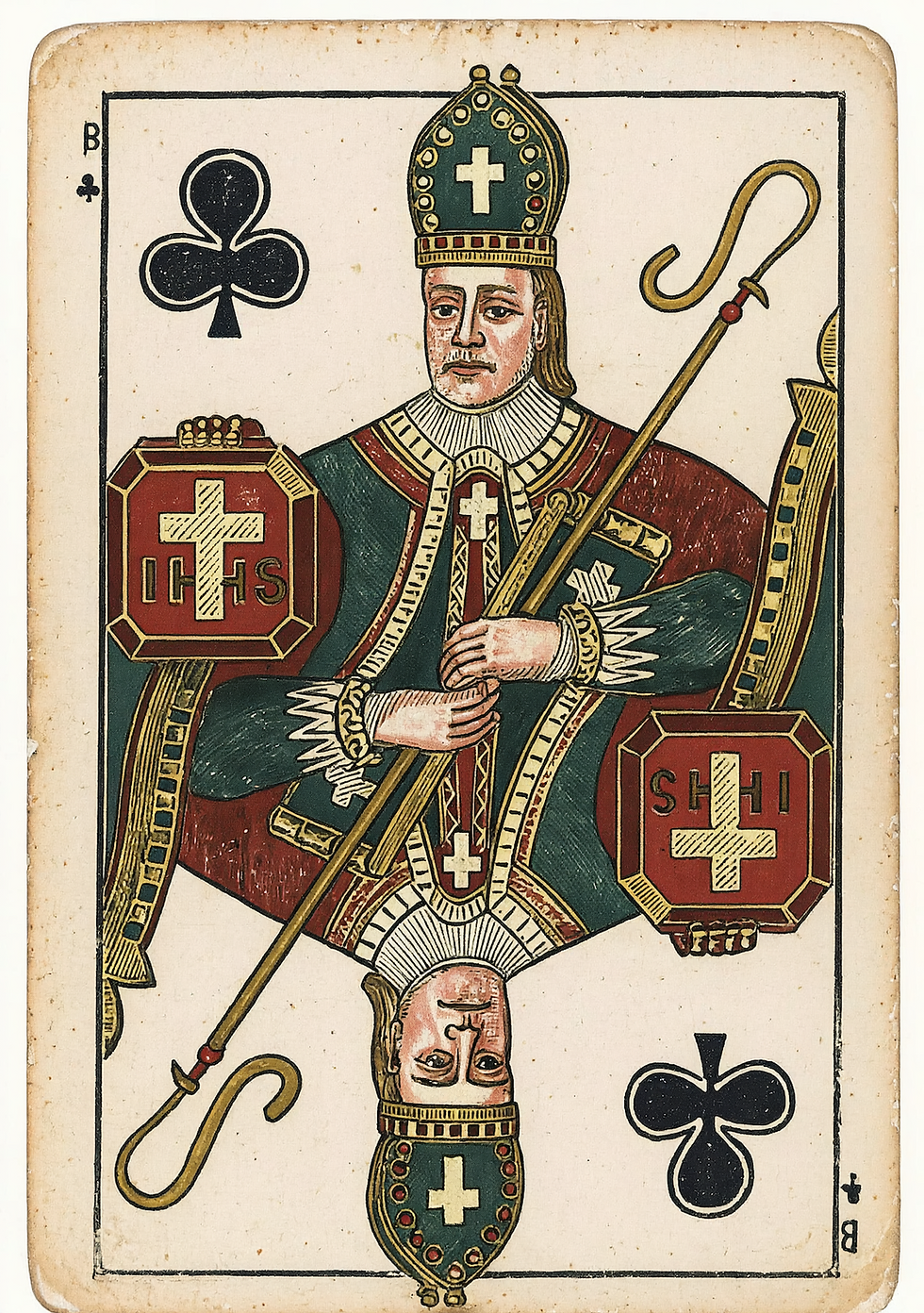
Here are the Bishops, which we have redrawn from the Squires in the original pack:

When it came to the Castle cards, we decided to find four recognisably different German castles, and isolate the buildings for the imagery, recolouring it to match the chromo palette:

These are:
Spades - Kriebstein Castle in Saxony, Germany.
Hearts - Fischbach Castle in Silesia
Diamonds - Lörsfeld Castle in Kerpen, Germany.
Clubs - Burg Eltz Rhineland‑Palatinate
Our extended Bishops Whist pack
We wanted our deck to be as useful as possible, so we have included the Aces, 10s, and suited knights as well. We have also added a joker card in the form of Till Eulenspiegel, drawn from a nineteenth century poster, and true to his name, reflected rather than inverted.

Here are the full set of 65 cards:

So, you can either play Bishops Whist, conventional games (including Dana's Roquet), or make up some that have the 60 suited cards and the 4 suitless knights, which might be termed Landsknecht as opposed to Lehnsritter when all 8 knights are used.
We'll explain more about the games below, but if you want to go right ahead and get a pack, they are available here at Make Playing Cards, printed on demand.
We have also devised a variant on the French Tarot pack game, L'Excuse, which we call Apology, which we will describe below. And as usual, we have worked out a solitaire game to play as well.
Bishops Whist the Game
Bishops Whist itself is (over and above the historico-philosophical investigations into the nature of a court card) a novel approach to card playing.
It is a trick-taking card game for 4 players in fixed partnerships (similar to traditional Whist) with special cards and unique rules.
To repeat what was mentioned above, the game features a modified International Pattern deck including castle-aces, bishops, and knights, creating a medieval-themed twist on classic Whist. There is an intelli gent reasoning for this, which is in the essay Dana wrote included below.
The Deck
A standard 52-card deck with modified court cards:
Castle-Aces (replacing traditional aces)
Kings and Queens (traditional)
Bishops (replacing Jacks)
Knights (replacing 10s) - Knights have no suit designation (no pip)
Number cards 9 down to 2 (traditional)
Card Rankings
Within each suit:
Castle-Ace (highest)
King
Queen
Bishop
Knight (functions as a 10 in non-trump suits)
9, 8, 7, 6, 5, 4, 3, 2
Setup
Players sit across from their partners
Dealer shuffles and places the deck to their right
Player to dealer's right cuts the deck
Dealer turns up the top card of the bottom portion - this becomes the trump suit
If a Bishop is turned up, the dealer's team scores 1 point
If a Knight is turned up, the dealer announces which suit will be trump
Dealer distributes 13 cards to each player, one at a time
Gameplay
Basic Rules
Player to dealer's left leads first
Players must follow suit if possible (with exceptions for Knights)
Highest card of the suit led wins the trick (unless trumped)
Trumps beat all non-trump cards (except in the final trick)
Winner of each trick leads the next trick
Knight Rules
Knights have no suit designation and never have to be played
In non-trump suits, Knights rank as 10s
In the trump suit, Knights have no rank (except in the final trick)
In the 13th (final) trick, Knights outrank all cards including trumps
If multiple Knights are played in the final trick, the last Knight played wins
When a Knight is led, players may play any card they wish (the "Irregular Trick")
The Knight's Revoke
If a player has only a Bishop of the led suit, they may play a Knight instead
This is called the "Knight's Revoke" and carries no penalty
This rule applies to any suit including trumps
Scoring
Each trick over 6 wins 1 point (maximum 7 points per hand)
Each Bishop in your team's tricks is worth 2 points (maximum 8 points)
Bishop turned up as trump card: 1 point for dealer's team
Every hand is played out in full; once a hand ends with a team at 25 points or more, that team wins the game
Penalties
Exposed card: Loss of 2 points
Regular revoke (failing to follow suit when able): Loss of 4 points
A revoking side's score can never be the one that wins the game
Key Strategies
Try to capture your opponents' Bishops (worth 2 points each)
Protect your own Bishops using the Knight's Revoke when needed
Save Knights for the final trick where they become the most powerful cards
Keep track of Bishops and Knights that have been played
The 12th trick is often strategically crucial for setting up the final trick
Dana's Summary:
The Game
Bishops Whist is played with a full pack of 52 cards, containing as new or special cards, castle-aces, bishops, and knights without pips, showing that they do not belong to any one suit, but simply to the card pack as a whole. The first thing to do after the cards have been shuffled is to decide partners and who shall deal. Partners may be taken by mutual choice if agreeable to all, the cards may be cut, or thrown around the table, the two highest and two lowest playing together. The lowest bestows the deal.
Before distributing the cards, the dealer lays the entire pack upon the table at his right, when his right hand opponent, proceeds to cut (i e lift up a portion of the cards), In so doing he must lift up more than four cards. The dealer himself now takes the topmost card of the packet underneath and lays it face up in the center of the table. This card forms the trump card and belongs to the dealer, and determines the trump suit for that hand. Thus it will be seen that the trump suit is shown before the cards are distributed around the table. Should this trump card so thown, happen to be a bishop the dealer’s side is entitled to score one point for bishop trump honor cut. In case, however, that a knight chances to be thrown, the dealer names aloud the trump suit before he touches the pack. Having now established the trump suit for that hand, the dealer proceeds to distribute the cards, dropping the first card to his left hand opponent, next card to his partner, next to his right hand opponent, and lastly to himself, and so on around until the entire pack is distributed. The last card in the pack falls to his right hand opponent, and the dealer now draws the trump card, which has all this while laid face up in the middle of the table, to his side. The player at the dealer’s left now plays a card, the dealer’s partner plays next, then the player at the dealer’s right, and the dealer last. The highest card of the suit led takes the trick (except on occasion when a knight chances to be played on the trick, or in thirteenth trick). The castle-ace is the highest card in its suit, king next, queen next, bishop next, then the knight, then the 9, 8, 7, 6, 5, 4, 3, 2. Trumps are always the superior cards, as in old whist, except alone in the last or thirteenth trick of each hand, when the knight outranks all other cards, trumps not excepted. Whoever takes the trick leads first for next trick and so the play goes on in regard to the consecutive play for tricks exactly as in old whist. Each player is obliged to follow suit if he can, except on one important occasion, viz; when a suit is led and you hold no other card of that suit except the bishop, you may (at will) hold back your bishop and pay a knight in lieu of the bishop. The play of knight for bishop, constitutes the “knights revoke,” and is duly explained under that head. When a suit is lead and it comes your turn to play if you have no card of that suit you are at liberty to trump or throw on any worthless card of any suit, as in old whist. This act is termed discard. All tricks over six counts one point as in old time whist, and in addition, each bishop counts two points to those who are able to display him among their trick cards at the close of the play for the hand. The understanding of this must be that each bishop is an honor, but yet counting nothing for the mere holding of him in your hand, that is, having a bishop dealt to you counts nothing unless you manage to save that bishop in the play of the cards and produce him among your cards after the hand is played out. The deal goes around to the left as in old whist. Sixteen points are possible to be made at any one hand, eight points from bishops, two points for each, and seven points by tricks, and in addition, one point for bishop cut the dealer for trump card. The last, or thirteenth trick, of each hand played is the knight’s trick, wherein the knight outranks all other cards of whatever suit or grade, not excepting the ace of trumps. The last knight played on the trick outranks all other knights. In case no knight happen to be played on thirteenth trick, then the cards hold their usual rank.
Twenty-five points constitutes a game, or as many more than twenty-five as may be won by either side in that hand wherein twenty-five points have been gained. Every hand dealt is required to be played out to the last trick and neither party can claim the game on gaining twenty-five points before the hand is played out. Example of last hand of a game : A and C stand at 24—B and D at 22 points. Another hand is played entirely out, A C stand at 26 points, B D have 29 points, B D win the game.
Abstract of the Game
In order that the student may compare the salient points in Bishops Whist with the chief characteristics of old whist we present a brief of the new game :—
1. Played by four players with a pack of 52 cards.
2. Thirteen cards dealt to each player and thirteen tricks played, for each hand.
3. All tricks above six count one point.
4. Castle-ace highest card in each suit.
5. Twenty-five points a game.
6. No jacks or tens, as the bishop takes the place of the jack, and the knight ranks as a ten.
7. Trumps superior cards, except in thirteenth trick.
8. Bishop cut the dealer as trump card, counts dealer one point.
9. Each bishop saved or captured from opponents, counts two points.
10. Trump card turned and shown before the cards are dealt
11. Sixteen points possible in any one hand.
12. Dealer sometimes obliged to choose the trump suit.
13. Obliged to follow suit except in case of “knight s revoke.”
14. May in some instances sacrifice a knight to save a bishop.
15. Four cards (knights) which have no pip and hence belong to no one suit, but to the pack at large.
16. Holding one or more knights cannot be compelled to part with them, but may (at will) hold them back throughout the play of the entire hand.
17. Four cards in the game, (knights) any one of which ranks as a tenspot in any suit which leads (except trumps).
18. Four cards which have no rank in the trump suit except in the last or thirteenth trick.
19. Four cards (knights) anyone of which may stand as a guard to your bishop.
20. Four cards (knights) any one of which led for a trick give all the players liberty to play any card of any suit they may please.
21. Four cards (knights) any one of which may rank as supreme card in thirteenth trick.
The Rank of the Cards

The castle-ace is the highest card in its own suit. The king comes next, the queen next, with the bishop as fourth best in his own suit. Notice that the four highest cards, castle-ace, king, queen and bishop, are set apart merely to emphasize the fact that their rank is rigid and never varying under any circumstances.
The bishop’s rank never varies; he is simply the fourth best card exactly as on the chess board. The bishop of trumps is styled the “cardinal” and always ranks as the fourth best trump. Having disposed of the four highest cards of each suit, we come, next, in our downward course to the knight, whose powers are not so easily disposed of. For a short and moderately comprehensive statement the knight ranks next below the bishop in all suits except trumps. More plainly yet perhaps: the knight ranks as a tenspot in any suit that leads except trumps. Next in order below the knight comes the 9, 8, 7, and so on down to the 2, as lowest card. The rank of the knight being at times so peculiar, requires an illustrated article under heading of “the knight” to which the student is referred. It may be said here that to acquire the game of Bishops Whist is but to gain a clear conception of the rank of the knight, all else is simple.
Laws of the Game
Forming the Table
Similar laws may apply in the new game as govern in old whist, concerning minor details. Four players form a table, and partners may be determined by mutual choice, if agreeable to all concerned, if not, the players cut or throw around cards for partners. In cutting, the castle-ace is the highest card, king next, queen next, bishop next, with the knight ranking above the 9, and below the bishop. The two highest and two lowest play together. The lowest cut bestows the deal. In the event that two players cut cards of equal value, they cut again should these cards chance to be intermediate cards. Example: a 7, two knights, and a king, are cut, the two knights cut again and the lowest plays with the 7. If three players cut cards of equal value, they cut again, and if the fourth player has cut a higher card, the two lowest play together. The first original low card cut stands as original low.
Cutting the Trump Card
Having shuffled the cards the dealer now places the entire pack, backs up, on the table at his right hand, when his right hand opponent lifts any number of cards, conventionally not less than four. The dealer now raises the topmost card of the bottom portion of the pack and lays it face up in the center of the table, in plain view of all the players.
This card forms the trump card and establishes the trump suit for the hand. Thus, it is understood that the trump card is shown before the deal begins. Should this card happen to be a bishop, the dealer’s side is entitled to score one point for bishops honor. The dealer, now, leaving the trump card in the center of the table, reunites the two packets, invariably placing the topmost packet underneath, and distributes the entire pack by one at at time beginning at the left hand as in old whist and dealing around the table. The last card dealt falls to the dealer’s right hand opponent when the dealer draws the trump card which all this time has laid in open sight, to his side. He leaves this card face up on the table until it is his turn to play to the first trick, when he gathers it into his hand. The trump card must be taken into the dealer’s hand before the first card is played to the second trick.
On Cutting a Knight for a Trump Card
It must be laid down that whatever card is thrown for a trump card, such card belongs to the dealer as his inviolable heritage for that hand. The knight often proves a valuable card, invested on occasions with rare and distinctive powers, and since he carries no pip to indicate to what suit he belongs, it follows of very necessity, that when a knight is turned as trump card he cannot indicate any particular suit as trumps. A knight being thrown or turned as trump, the dealer following the regular order, lays this card face up in the middle of the table, and before touching the cards to deal announces in a clear and distinct voice what suit shall be trumps for that hand, exercising his own free will in thus naming the trump suit. After announcing the trump suit, and never before, the dealer reunites the packets, being careful to place the topmost portion, (i.e. the cards which the opponents lift up) underneath, and proceeds to deal as usual, after which he gathers the knight into his hand. No harm occurs if the players make a note of the suit named as trumps as the trump is often forgotten and sometimes in dispute in the course of the play.
The Deal
Goes around to the left, each one dealing by turns. There must be a new deal, by the same dealer, if while dealing, any of the player’s cards are thrown face up, or if one or more cards are found face up in the pack, or that he deals more than or less than thirteen cards to any of the players and the mistake is discovered before the first trick is gathered in.
The Misdeal
It is a misdeal:—
I. If, when a knight is thrown as trump card, the dealer’s partner touches any of his cards before the dealer announces the trump suit.
II. If the dealer touches the pack before announcing the trump suit, (when a knight is thrown as trump card.
III. If, after the trump card is thrown, the dealer, reuniting the two packets, fails to put the topmost packet underneath.
IV. If, in raising the trump card, he faces up any of the cards underneath.
V. If, in dealing, the last card in the pack fails to fall to his right hand opponent.
VI. If he deals any card or cards face up, either to himself or any other players.
The misdeal loses the deal which passes to the left hand adversary. In the misdeal, if a bishop has been thrown for a trump card, the point for bishop cut is lost with the misdeal.
Exposed Cards
I. Are any cards displayed or led out of turn.
II. More than one card played upon a trick.
III. A card played upon any trick by mistake, or otherwise, and taken back into the hand before that trick is gathered in.
IV. Any card whatsoever, dropped, or in any way laid upon the table out of the regular order of play.
V. Exposed cards must be taken into the hand again. The penalty for exposed cards is the loss of two points to the delinquent’s score.
The Revoke
When a suit is led and you having a card of that suit keep it back, playing a card of some other suit, it is a revoke, or more simply yet, a denial of suit led. It is not a revoke, however, if a player, thinking he has no card of the suit led, plays a card of another suit, and discovering his mistake before that trick is gathered in, plays the right card. In such a case the players who may have played after him can withdraw their cards and not suffer the penalty of exposed cards.
At the conclusion of the hand the claimants of a revoke may search all of the tricks.
If any side charges a revoke upon its opponents and they mix their cards, before giving the accusers a chance to verify their charges, the revoke is established. No score made by a revoking side can win the game. The penalty for a revoke can be enforced for as many revokes as occur in the hand. The penalty of a revoke is the loss of four points to the delinquent’s score.
The Knight’s Revoke
The inevitable law in old whist that you must always follow suit whenever you can do so holds good in Bishops Whist, with but one important exception. This one exception is termed the "knights revoke," to which no penalty appertains. When a suit is led, trump or nontrump, and you hold no card of that suit except the bishop, you may refuse to part with your bishop, and instead, play a knight in lieu of your bishop. Should the suit come around again you may again refuse to play your bishop, and again drop on a knight, and so continue to play knights, in lieu of bishops, provided of course you are lucky enough to hold any knights. Trumps are not excepted in this rule, which is to say: suppose trumps lead and you hold the bishop of trumps and no other trump, you, holding a knight, may play him in place of the bishop. Thus any knight, or any number of knights you may be lucky enough to hold, may be sacrificed, at will, to save your bishop. The historical reason for the knights revoke may be summed up as follows : James I of England, adopted it as his fixed maxim : no bishop, no king. To say, no king, was in feudal days, equivalent to declaring "no country". The knight was bound by an oath to defend both his religion and country, and since, without the bishop, neither king nor country existed, the bishop most fittingly symbolized both religion and country. Since then the bishop stood for so much, both in religion and the state, and as the knight was bound by a vow to defend both, it becomes most fitting that the knight in obedience to his sworn oath should sacrifice himself for his bishop.
Sample game
(In his booklet, Dana includes a sample game played out in full, which we include verbatim.)
An illustration of the knights revoke may be of service. Suppose the following, hearts trumps :
The players are seated at the table in order, C to deal.

The cards having been shuffled, C lays the entire pack upon the table, at his right, within easy reach of his right hand opponent who lifts a portion of the cards (cuts) raising more than four cards in this act of cutting, C takes the topmost card of the packet underneath and lays it face up in the center of the table in plain view of all. This card proves to be the 5 of clubs and designates the trump card and suit for this hand. C now proceeds to deal the cards, one at a time, beginning at his left as in old whist and dealing around thirteen cards to each player. The last card in the packet falls to his right hand opponent, when C draws in the 5 of C leaving this card face up on the table until after the first trick is played for A to lead.
| A’s Hand | B’s Hand | C’s Hand | D’s Hand |
Hearts | Q, B | C, 9, 6, 5 | 2, 3 | K, 4, 7, 8 |
Diamonds | C, B, 4 | 8, 9 | K, Q, 3, 5 | 2, 6, 7 |
Clubs | 8, 9 | Q, B, 3 | C, K, 4, 5 | 2, 6, 7 |
spades | C, 2, 4, 6 | K, 5, 7, 9 | B | Q, 3, 8 |
Unpipped | Two Kts |
| Two Kts |
|
Notice that C holds only the bishop in spades, but the two knights make the suit three cards long, in case C wishes it so. When the S suit comes around C may (at will) make the “knights revoke” twice A also holds two bishops poorly guarded, (hearts and diamonds.) The two knights assume kinship with the bishop, when no card of the bishop’s suit remains, but the bishop, as we shall see.
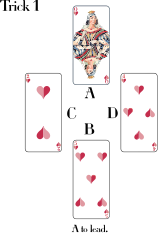 | Trick 1. A leads queen, D plays 4, B plays 5, C plays. 2.—This trick goes to A—A led queen in hopes to get out the castle-ace and king on the first round when he could have saved his bishop on the second round of the suit. Were it not for the knights his bishop would now be absolutely without protection. |
 | Trick 2. A leads castle-ace, D plays 3, B plays 5, C plays knight, A’s object in leading castle-ace of course was to catch the bishop, B since he held no other cards of the spade suit but bishop, executed the “knights revoke” thus protecting his bishop. |
 | Trick 3 goes to B, cheaply enough. All the players understand that the lead of a low card early in the hand indicates one of two things viz., that the leader has the bishop of that particular suit or that his holding is characterized by great poverty. B leads king of s. C plays knight. A plays 2 D plays 8. |
 | Trick 4 goes to B—Here again we see how valuable a card the knight often becomes for C has refused to part with his bishop and sacrificed a knight in lieu of bishop (knights revoke) All the players know to a certainty now that C has the bishop of spades. B leads castle-ace. C plays 3. A plays knight. D plays 8. |
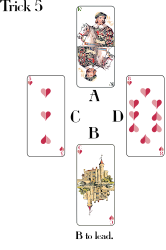 | Trick 5 goes to B. B plays castle-ace of hearts with the sole object of catching the bishop of that suit. A having parted with his queen in the first trick has now no cards in hearts but the bishop and holding two knights he very properly makes the knights revoke. This saves his bishop for the time being. |
 | Trick 6—B leads 9 of s. C plays bishop, A plays 6, D plays queen. This trick goes to D as the queen outranks the bishop. Trick 6 shows the sometimes evil attending the play of a low card as opponents will sometimes make the bishop. |
 | Trick 7.—D plays king of h, B plays 6, C trumps, A plays bishop.—This trick shows the proper use of trumps, i. e. to play to catch opponents bishops, C takes. A might have kept his bishop and again made the knights revoke, i. e. played knight in lieu of bishop, but it is well worth considering whether you part with your last knight to save the bishops. Recollect the knight is the supreme card in last trick and A also holds bishop of diamonds almost unguarded and may yet need his last knight to protect that bishop. |
 | Trick 8.—C leads castle-ace, A plays 8, D plays 2, B plays 3, C is simply swinging to catch the cardinal. This trick goes to C. |
 | Trick 9.—C plays king of C, A plays 9, D the 7, B the queen ; C takes. C continues to swing for the cardinal forcing B to part with his queen of trumps. The bishop of trumps now remains as the best trump not played and can B get a chance to lead him before the thirteenth trick comes off he may save him. In the maelstrom of last or fortunes trick, so soon now to occur, chance fortune will dispose of B’s bishop unless he makes good haste to secure him at once. |
 | Trick 10 goes to A as castle-ace outranks king. |
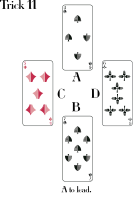 | Trick 11. A leads 4 of s, D plays 6 of c, B 7 of s, D 5 of D. This trick goes to D who makes haste to play a winning trump, when he can, as trumps to win must be played before “last trick” as then, the knights outranks all cards of whatever suit. |
 | Trick 12. As A had no spades he was at liberty to play either knight or bishop, on this trick. He knows that only one knight remains unplayed, that that knight being in his own hand will certainly capture next trick. He also understands that bishop of trumps is yet unplayed and consequently that although he loses a bishop on this trick he captures another one in the next trick to compensate. This trick very well illustrates the interesting and somewhat dramatic situation that concenters about twelfth and thirteenth trick If A plays knight on this trick, in lieu of bishop, he loses both tricks, and also the bishop of trumps which is sure to come down on last trick. C leads queen d, A plays knight, D plays 6 of d, B plays the cardinal. |
 | A’s knight captures the cardinal with “last trick”. In case no knight had been played on this trick the cardinal would have taken the trick as when no knights chance to be dropped on “thirteenth trick” the cards retain their usual rank with trumps the superior cards. |
60 card Roquet
Prior to Bishops Whist, Dana patented the scoring mechanism for another game he had invented, Roquet. Since the rulebook doesn't mention croquet at all, the name may derive from the French for castling in chess, and the game has terms like coup and petit check, and all this suggests an approach to game design later manifested in Bishops Whist. The field between the players is called the livret, and the play is described as contretemps.
We will make the patent and rulebook available for download, but here is a simplified version for making use of a 60-card deck, Ace, 2-10, Lehnritter (suited Knights), Bishops, Queens, Kings and Castles.
Roquet
for the Bishops Whist deck
Adapted from A. T. Dana's original Roquet (patent US 507,111, 1893; booklet c. 1899)
The pack
60 cards: four 15-card suits, (Landsknechts and the Fool set aside).
Rank, low to high: Ace, 2, 3, 4, 5, 6, 7, 8, 9, 10, Lehnritter, Bishop, Queen, King, Castle
Ten numeral ranks (Ace–10) and five court ranks (Lehnritter, Bishop, Queen, King, Castle) per suit — against the original pack's ten numerals and three courts (Jack, Queen, King). This is the one structural change that reshapes the game: where Dana had three ranks eligible for a "royal" pair, this pack has five.
Setup
• Players: 2
• Deal: 8 cards to each player
• The Livret: 4 cards laid face-up in the center at the same time as the deal
• Trump: turn the next card to fix the trump suit
• Stock: the remaining 40 cards, face-down, for replenishing hands during play
Trick play
• Two cards to a trick.
• Follow suit if able. Higher card of the suit led wins, per the rank order above — Ace low, Castle high.
• Any trump beats any non-trump.
The meld phase
Unchanged from the original, and still the heart of the game: a player may lay down and discard scoring combinations from their hand only in the moment immediately after winning a trick, never before it.
• Having won a trick, a player may draw one card from the livret to complete or improve a combination, then discard the finished combination and bank its points.
• The turned-up trump card is likewise available as meld material once in play, as in the original.
Scoring
Combination | Points |
Pair (two cards of matching numeral rank, Ace–10) | 2 |
Royal pair (two cards of matching rank among Lehnritter, Bishop, Queen, King, Castle) | 5 |
Sequence of 3, same suit | 3 |
Sequence of 4, same suit | 4 |
Sequence of 5, same suit | 5 |
Muster (all four suits of one rank) | 10 |
The pair/royal-pair values carry over directly from Dana's confirmed figures. The sequence and muster values are this adaptation's own house rule, not Dana's — the original booklet never assigns numbers to those, so there was nothing to preserve there and no reason not to set them cleanly.
The consequence of the five-court-rank suit: royal pairs simply become available on five ranks instead of three — Lehnritter, Bishop, Queen, King, and Castle can each pair for 5, where the original pack only offered that on Jack, Queen, King. Nothing else about the tariff needs to change; the wider court simply gives the meld more opportunities to occur, which should make the game a little richer in royal pairs per hand without altering their individual value.
Ending a hand and the match
• Play continues, hands replenished from stock after each trick, until stock and hands are both exhausted.
• Total each player's banked meld points for the hand; add straight onto their running game score — no conversion, no remainder.
• First to 100 wins the match.
Strategic note
Dana's "great campaign" idea — refusing an easy early meld (specifically, the trump card) to build toward a much larger one later in the hand — translates over unchanged, and arguably gains a little more room to work with here: with two extra court ranks in play, there's more material available for a player patient enough to hold off cashing in early.
Apology - another game for a Bishops Whist deck.
Given that the Landsknecht knights are in a way joker/fool cards, we can co-opt a French game played with a Tarock deck, L'Excuse. These are draft instructions, we welcome feedback.
A four-player trick-taking game modeled on French Tarot's treatment of L'Excuse
The pack
65 cards: four 15-card suits (Ace low through Castle high), the four Landsknecht, and Till Eulenspiegel.
Suit rank, low to high: Ace, 2, 3, 4, 5, 6, 7, 8, 9, 10, Lehnritter, Bishop, Queen, King, Castle
The Ace/Castle pairing at the bottom and top of each suit stands in for French Tarot's Petit and 21 — the two bookend cards around which that game's special scoring turns. Till Eulenspiegel plays the part of the Fool.
Setup
Players: 4
Kitty: the 4 Landsknecht and Till Eulenspiegel — 5 cards — are set aside, unseen, before dealing.
Deal: the remaining 60 suited cards are dealt evenly, 15 to each player.
Bidding
Each player, in turn, bids or passes. The highest bidder becomes the taker, playing alone against the other three for the hand, at a single flat stake — no contract-tier ladder. If all four pass, the hand is thrown in and redealt by the next dealer.
The exchange
The taker turns up and takes the 5-card kitty into their hand — 20 cards total.
The taker then buries 6 cards, face-down, of their own choosing — from the kitty, from their original hand, or any mix of the two.
The buried cards count toward the taker's score at the end of the hand but take no further part in play.
This leaves the taker with 14 cards in hand, against 15 for each of the other three players — a deliberate one-card toll for the exclusive first look at the kitty. No one else ever sees or touches the Landsknechts or Till unless the taker declines to bury them.
Trick play
Follow suit if able. Highest card of the suit led wins the trick, per the rank order above.
There is no trump suit in this game — the Landsknechts and Till function as the wild element instead, in place of a trump suit, per the rule below.
Landsknechts and Till in a trick — the L'Excuse rule
A Landsknecht or Till may be played to any trick at any time, whether or not the player could otherwise follow suit — playing one is never a fault.
It never wins the trick. The trick is won by whoever played the actual highest card of the suit led, exactly as if the Landsknecht/Till weren't there.
The player who played it hands the trick's winner one low card from among their own previously won tricks, in exchange for having escaped the trick's obligations.
Exception — the last trick. If a Landsknecht or Till is played on the final trick of the hand, there is no future trick in which to make that exchange, and it is captured outright by the trick's winner. Holding one down to the last trick is a real cost, not a safe default.
Since only the taker can hold these cards (the other three players are dealt pure suited hands), this rule is entirely the taker's tool and risk to manage — their reward for winning the bid, and their trap if mismanaged.
Scoring
Every card carries a point value, won along with the trick it's captured in (or scored directly if buried by the taker):
Card | Points |
Ace–10 | 0.5 each |
Lehnritter | 1.5 |
Bishop | 2.5 |
Queen | 3.5 |
King | 4.5 |
Castle | 5.5 |
Landsknecht (×4) | 1.5 each |
Till Eulenspiegel | 4.5 |
Total pool: 100.5 points.
The oudler trio
Ace, Castle, and Till Eulenspiegel — the lowest suit card, the highest suit card, and the wandering outsider — function as the game's three oudlers, echoing French Tarot's Petit/21/Excuse. The taker's required score to win the hand depends on how many of the three they hold at the end:
Oudlers held by taker | Target needed |
0 | 62 |
1 | 56 |
2 | 45 |
3 | 40 |
(Proposed default, scaled proportionally from French Tarot's own thresholds against this deck's larger point pool — worth adjusting after a playtest or two.)
Captured Landsknecht/Till, and the escape payment
A Landsknecht or Till captured on the last trick transfers only its own point value to the capturer — no further penalty.
The low-card payment a player makes when successfully escaping a trick with a Landsknecht or Till can be any card from their own won tricks — there's no fixed minimum value it has to meet.


Comments