
Tujeon: Korea's card tradition

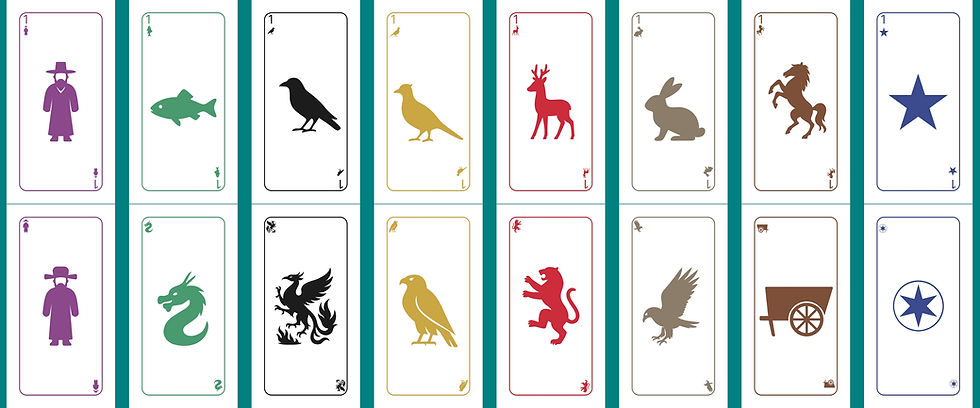
This is a new version of the traditional Korean playing cards tujeon (투전, 鬪牋) —literally "fighting tablets" — in modern international style. It is an 8 suit, 10 cards-per-suit, pack, with a suit for each of the 8 cardinal points of the compass. In each suit there are 9 numbered cards and one General card that is of a different, but associated kind.
The Tujeon tradition
Tujeon cards existed before hanafuda arrived from Japan in the 1870s. They were called Tujeon (투전, 鬪牋)—literally "fighting tablets"—and by the late 19th century, they'd become so associated with gambling that reformist scholars condemned them and the Japanese colonial administration eventually suppressed them. All of this contributed to their slipping out of the centre place they had enjoyed.
The card historian Stewart Culin examined three packs of Tujeon in American museums for his 1895 report to the U.S. National Museum on Korean game practices. He documented an 80-card pack (eight suits of ten cards each), a 60-card pack (six suits), and a 40-card pack where suit marks had disappeared from numeral cards entirely. He also referenced a manuscript by missionary and card historian H.B. Wilkinson, who'd observed gameplay in Korea.
Traditionally the suits and ranks were indicated with calligraphy, and were painted on narrow strips. these are the illustrations from Culin (1895):
The Joseon scholar Yu Deuk-gong, writing in his Gyeongdo Japji (京都雜誌), recorded that the eight suits had symbolic names: 皇龍鳳鷹虎極鷲乘—Emperor, Dragon, Phoenix, Eagle, Tiger, Polaris, Condor, Wagon. He also noted that four suits (star, horse, deer, rabbit) were designated 少 ("young") while the other four (man, fish, crow, pheasant) were 老 ("old"), and that the "young" suits had reversed card rankings.
Young
Saram (사람) - Man/King
Mulgogi/Yong (까마귀/봉황) - Fish/Dragon
Kkamagwi/Bonghwang ( 까마귀/봉황) - Crow/Phoenix
Kkwong/Mae (꿩/매) - Pheasant/Falcon
Old
Noru/Horangi (노루/호랑이) - Roe Deer/Tiger
Tokki/Doksuri (토끼/독수리) Rabbit/Eagle
Mal/Sure (말/수레) - Horse/Wagon
Byeol/Bukgeukseong (별/북극성) - Star/North Star
Our version
In our new version of it we have used modern international card layout conventions, with simplified iconic suit pips in differentiating colours, and added index markers for convenience. The iconography is simplified and semi-abstract, inspired by the manner in which Western suit pips evolved from elaborate court imagery into minimal symbols.
Here are the 80 suit cards (there are also two blank wild cards).

We have used traditional Korean dye colours in the design.
Jaju (자주) - gromwell purple
Yeokrok (역록) - jade green
Sumuk (수묵) - ink black
Geumsaek (금색) - gardenia gold
Juhong (주홍) - safflower crimson
Ppong (뽕) - mulberry bark taupe
Galnok (갈녹) - chestnut brown
Jjoksaek (쪽색) - indigo blue
Tujeon Games
The games themselves are barely documented. Yet-pang-mang-i (엿방망이, "sweetmeat pestle") was the most popular: a baccarat-like game where players tried to reach nine by adding card values, suits ignored. Another game called Tong-tang was compared vaguely to Chinese Khanhoo by Wilkinson (who westernised that game in England to some renown).
We also don't know the structure of the smaller packs. Convention assumes 40 cards means four suits of ten, but Culin notes that numeral cards in pack (c) were "marked alike"—suit distinctions had vanished. So it could well have been 5 sets of 1-7 and five Generals, which would account for the 25-card pack, mentioned in Korean sources with no explanation of its structure. It might well be 5 Generals and 5 copies of 1-4. Given the cards were marked with numbers leaving off the suit characters would have been enough.
For Yet-pang-mang-i, the rules are relatively clear: any number of players, one dealer, draw cards to reach nine (or closest without going over), tens don't count. Three matching cards beat nine. That much survived.
For other games, we have adapted rules from the early hwatu (화투) games—jjitgoddaengi and jjokgi were originally Tujeon games.
You can buy a set of our Tujeon cards printed-on-demand at Make Playing Cards here


Comments