
The Liechtenstein Five Suit Pattern

We mentioned in a previous post the mayfly life of the 1938 five suit bridge suits—Leaves, Crowns, Castles, & Eagle—that seem to have vanished as quickly as it arrived, lost to all but collectors.
The reason for settling on 4 suits in card packs has been variously attributed to the number of the season (the four corners of the earths orbit), the four temperaments, the four elements to name a few. But on the way to four-suit modernity there were as many as 9 suits (in EG Ganjifa) and as few as three (traditional chinese sets).
One of the earliest European packs—the celebrated ca. 1500 playing circular cards of the master PW—had five suits, none in common with any modern pattern. The 14 card suits were parrots, hares, carnations, columbines, and roses. There was also a death card.
The pack of interest to us was purportedly from 1470, but was discovered in the 1860s. It is called the Liechtenstein'sche Spiel and is in the Rothschild collection in the Louvre.*
The Liechtenstein pattern presented a curious fusion of Swiss and Tarot suits: Shields (Swiss) and Cups, Coins, Swords and Batons.
Drawing on our simplified patterns for those traditions, we assembled a modern a modernised Liechtensten pack:

We used the Piatnik courts for shields and the Genoese style courts from Goodalls for the Tarot suits:

There is no record as to the rules, but any of the Yankee Notions games can be played with it, as well as Quintract and 5-suit Poker.
You can buy a copy printed on demand at Make Playing Cards here.
* Paris, Musee de Louvre, Coll. Rothschild, Inv.-Nr. 3806 LR. As one writer has it "Das Liechtenstein'sche Spiel is very interesting, as it might be the oldest example of a cheap card deck."
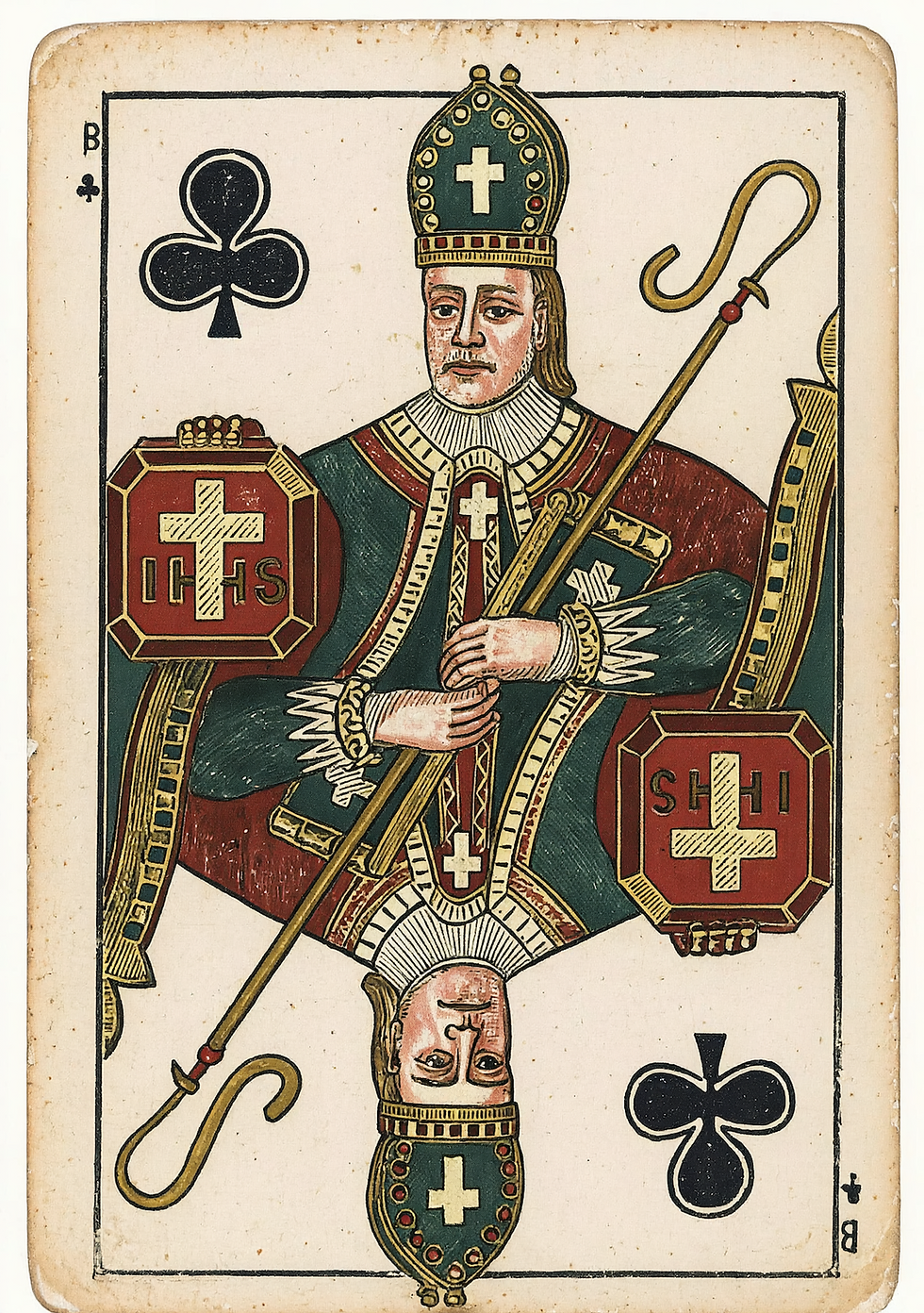
Here is the fragmentary original:



Comments